
Overview
As social media becomes an increasingly dominant part of student life, students themselves are seeking more opportunities for deeper, face-to-face conversations. Games are already a significant part of MIT campus culture—from board game nights to collaborative problem-solving. This raises a compelling question: Can structured game experiences that lead students to ask deep questions and tell stories serve as an acceptable and effective form of conversation design on campus?
As part of the realtalk@MIT initiative, we explore how playful methods can help the MIT community build trust and create avenues for genuine listening across students, staff, and administration. Building on projects like Analogia, Beyond-the-Ice, and Closer Worlds, this work investigates how games can facilitate meaningful social discourse.
Research Question: How might we create experiences that motivate the MIT community to engage in more authentic dialogue and deep listening?
Co-Design as a Dialogue Practice
Making is deeply embedded in MIT’s community culture. We position co-design not just as a method, but as a form of dialogue that resonates with this making tradition. By bringing students together to imagine, discuss, and prototype social games, the design process enacts the very conversational practices it seeks to study.
Participants are guided to build their own social game interventions and test them within their networks, creating a community of makers who invent grounded, novel ways to facilitate honest conversation. Students are experts in their own social experiences—rather than prescribing solutions from above, co-design allows the community to name its own needs and imagine interventions that feel welcome and culturally resonant.
The resulting games carry legitimacy precisely because they emerge from the lived experiences of the community who will play them.
Three-Phase Process
Phase 1: Co-Design Workshop (August 2024)
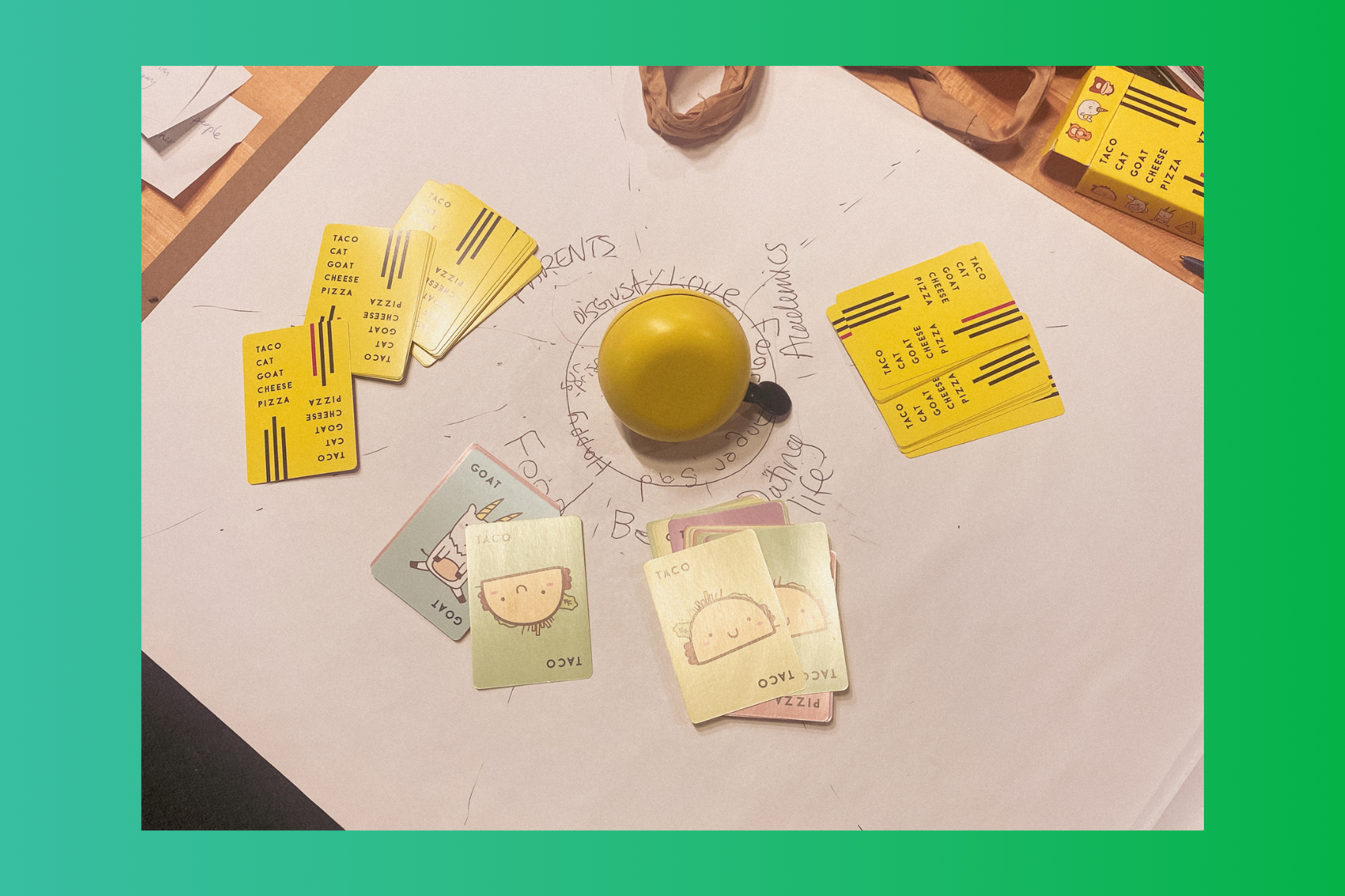
Six students spent two days developing principles for games designed for and by students, producing three proof-of-concepts:
- Dorm Quest: Decentralized weekly quests that reveal a collaborative image at semester’s end
- Sudden Plunge: Emotion-driven board game with “ring in” or “tap off” boundary signaling
- Let’s Talk: Physical conversation-prompting box for community spaces
Phase 2: Prototype Testing (January 2025)
Building on the principles discovered in the first phase, four students – Kailey Bridgement, Hazel Yonatan, Hanu Park, Daniel Figgis Gonzalez – built and tested two functional games:
- MITree: Grow unique trees with friends through conversation prompts; view your relationships within a community forest map
- Most Wanted: Card game which asks players to guess who in a group is “most likely” to “Use a time machine exclusively to mess with people”, “Dig a really big hole (like really big)”, “Have 10+ pets”, and more as a way to playfully create moments for personal sharing
Phase 3: Campus Trade (September 2025 – current)
Campus Trade is a large-scale social game created by Kayode Dada and debuted at campus orientation 2025. In this game, students trade cards featuring community-generated stories and art. To complete a trade, players must complete the conversation challenge on the card—transforming ice-breaking into structured, playful dialogue. Campus Trade addresses the challenge of starting conversations with new students by giving incoming students both tools and practice for initiating meaningful conversations.
Contribution
This work surfaces the dynamics of social interventions that students find both acceptable and exciting. The principles that emerged across all prototypes—personalization, agency over participation, visual progress, boundary signaling, physical artifacts over digital barriers—illustrate to designers what matters when creating conversational experiences.
In a landscape dominated by social media’s shallow interactions, students are hungry for structured experiences that facilitate depth. By co-designing their own conversational tools, students develop both the games and the skills to sustain them—learning to open up, extend conversations, and create space for others to get personal. The games become vehicles for practicing the very dialogue they’re designed to prompt, creating a sustainable cycle of connection rather than a one-time intervention.


